Robot Harbour / Physical AI platform
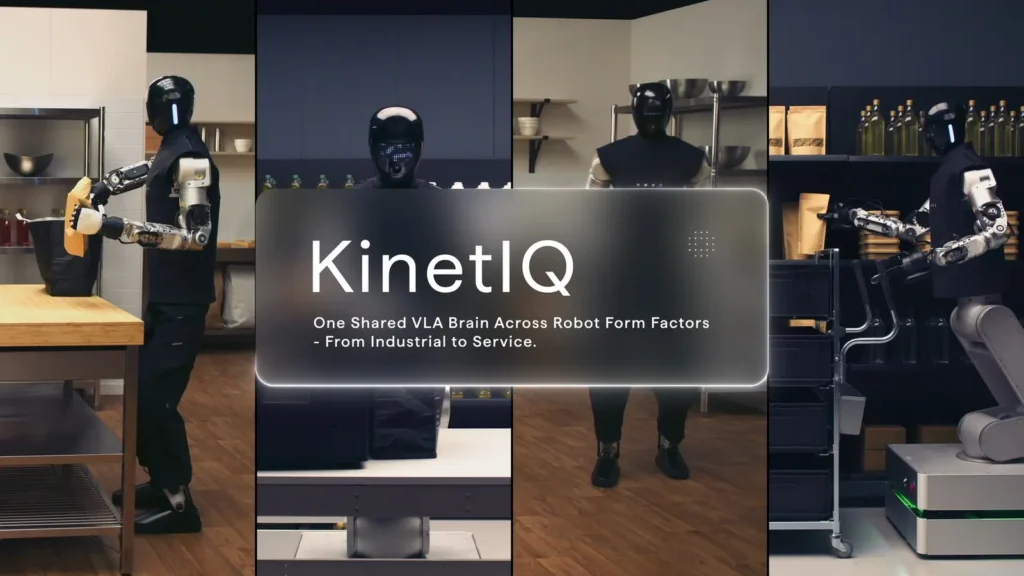
KinetIQ
Source-backed intelligence on the models, software and compute systems giving robots the ability to perceive, reason and act.
- Developer
- Humanoid
- Status
- Limited access
- Access
- Internal only
- First released
- 2026-02-05
- Systems
- HMND wheeled and bipedal robots; multi-robot fleets
- Last verified
- 2026-08-06
KinetIQ is Humanoid’s proprietary four-layer physical-AI stack for whole-body control, learned manipulation, single-robot task execution and multi-robot fleet orchestration.
Four connected layers
Humanoid divides KinetIQ into Systems 0 to 3. System 0 is the whole-body control layer that converts target poses into physically feasible joint commands. System 1 is a vision-language-action layer that turns natural-language goals and sensor input into short-horizon robot actions.
System 2 coordinates the capabilities of one robot, including navigation, manipulation, perception, recovery and human intervention. System 3 operates at fleet level, assigning work and integrating robot activity with warehouse, manufacturing and enterprise systems.
Cross-embodiment approach
The architecture is designed to share upper-body manipulation, task planning and orchestration between Humanoid’s wheeled and bipedal robots. Locomotion and low-level control remain specific to the physical platform.
Learning and deployment
KinetIQ combines classical control, reinforcement learning and VLA models. Humanoid describes a capability-development workflow using teleoperation, autonomous roll-outs, curation, training and evaluation. The company also runs VLA inference both on robot hardware and in the cloud, with asynchronous methods intended to reduce the effect of network delay.
Access and evidence
KinetIQ is not offered as a public API, open-weight model or standalone commercial SDK. It is an internal platform deployed through Humanoid’s robots and partner projects. Technical results published by Humanoid are first-party evidence; independent comparisons of reliability, throughput and transfer between robot bodies remain limited.