UK technology supplier Scan Computers has partnered with Sheffield-based OLO Robotics to combine robot hardware with browser-based software and deployment support. The collaboration addresses a practical obstacle for prospective buyers: purchasing a robot is only the beginning of getting useful work from it.
Details published on 13 October describe a combination of Scan’s hardware and AI infrastructure with OLO’s platform and engineering expertise. It is a UK commercial relationship with products and services already advertised, rather than a promise of future British availability. The announcement does not disclose contract values, customer numbers or independently verified savings.
From robot hardware to a working task
OLO’s Scan partner page focuses on the Unitree Go2 quadruped range. Its software brings remote operation, simulation and autonomous navigation into a browser interface. The proposition is to make these functions accessible without requiring every customer to assemble a specialist robot-software team.
That matters because the economic test is not whether a robot can walk around a demonstration area. It is whether a customer can configure a useful task, operate it reliably and obtain information or output worth more than the complete cost of deployment.
Services beyond the machine sale
Scan already advertises a broader robotics offering, including hardware selection, consultancy, training and technical support. Its service description includes maintenance, diagnostics and repairs for supported hardware, with optional service-level agreements and remote assistance. OLO adds a software and workflow component to that proposition.
The partnership therefore illustrates a route to recurring revenue beyond the initial machine sale. It also creates an obligation for suppliers to explain where the hardware warranty ends, who supports the software and who takes responsibility when an integrated system stops working.
What the published support packages cost
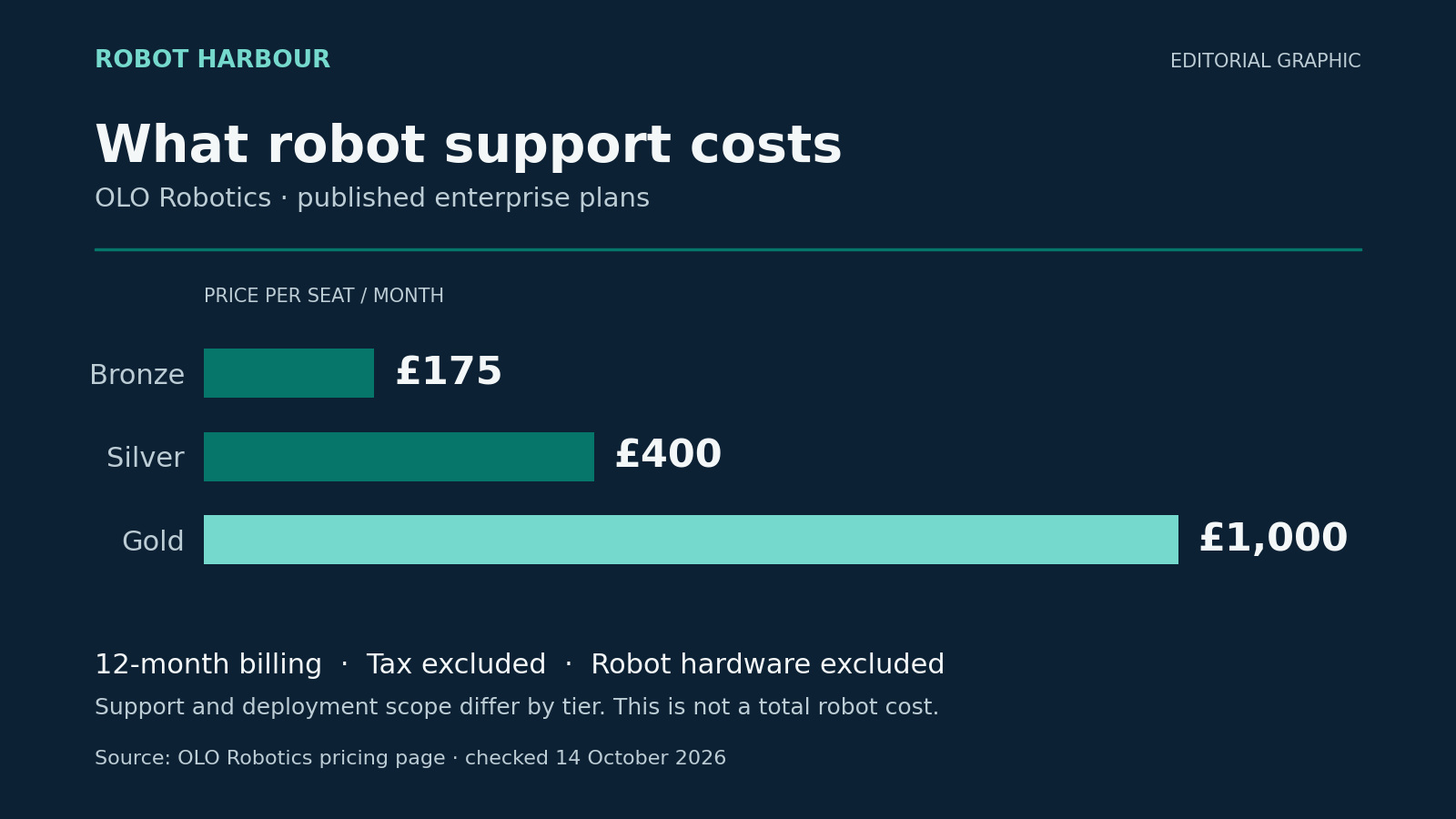
OLO’s published enterprise prices provide a useful glimpse of the ongoing costs. Its Bronze package is listed at £175 per seat per month for customers able to set up a supported robot themselves. Silver costs £400 per seat per month and adds assistance with setup and team training, covering up to three robots. Gold is £1,000 per seat per month, with in-person setup assistance and broader support.
The pricing page specifies 12-month invoice billing and excludes local taxes. These are software-and-support packages, not complete prices for robots, sensors and deployment. Nor are they necessarily the terms of a bespoke Scan quotation.
For buyers, the practical comparison should therefore include the number of operator seats, required support, hardware configuration and time spent preparing the site. A lower purchase price can be a poor guide to the cost of delivering a repeatable inspection or research workflow.
A UK training project offers limited evidence
There is some concrete evidence of OLO’s approach, although it should not be confused with a customer deployment under the Scan partnership.
In a separate DarbyTech case study, OLO describes an inspection system installed on a carbon-capture training rig at Redcar and Cleveland College. That project used a DEEP Robotics M20 Pro wheeled quadruped, rather than a Unitree Go2, equipped with thermal and visible-light cameras.
OLO reports four hours of preparation in simulation and 12 hours of onsite setup. Its account describes mapping the environment, defining inspection points, checking sensor feeds and adjusting the real-world route before scheduled inspections.
Those figures are supplier-reported, and the setting is an industrial training facility. They do not establish a typical implementation time or prove the financial return available at an operating factory. Their value is in showing the work required between buying hardware and running a defined task.
The evidence customers still need
Important questions remain unanswered for the Scan partnership itself. The announcement provides no baseline for engineering hours saved, inspection accuracy, operator interventions, uptime or customer payback. Buyers also need configuration-specific answers about connectivity, software access, data handling and recovery procedures.
For UK integrators and service businesses, the opportunity is consequently more specific than simply reselling a robot. It lies in defining a customer’s task, configuring the system, training operators and maintaining performance after installation.
The next useful evidence would be a named commercial customer reporting the complete deployment cost and operating results over time. Until then, Scan and OLO offer a credible British route to implementation, with the economics still to be demonstrated project by project.
For context, read our Physical AI guide and follow deployment and availability developments in the Robot Harbour Market Tracker.
Explore our directory profiles for Scan Computers, OLO Robotics and the Unitree Go2.
Reporting note: This article draws on the companies’ published material. Deployment figures are attributed to OLO and have not been independently verified by Robot Harbour. Prices were checked on 14 October 2026.
Image: Robot Harbour editorial graphic, based on OLO’s published pricing. Hardware costs are separate.