
Record funding is financing robot intelligence, autonomous fleets and new factories. The commercial test is whether that capital makes useful work more reliable and affordable.
Featured image: AI-generated editorial illustration by Robot Harbour.
A billion dollars buys very different things in robotics. It can fund the training of an AI model, the construction of a shipyard, or the machinery needed to manufacture thousands of robots. Those investments share a belief that computers will do more physical work. Their routes to revenue, and their chances of earning attractive returns, can differ sharply.
Business Insider reports that robotics and physical AI companies raised $33.4 billion globally in the first half of 2026, citing PitchBook, already exceeding the $28.7 billion recorded for all of 2025. The figure captures the intensity of investor interest. It does not tell us how much commercially useful automation has been delivered. [1]
Understanding this boom requires following the money beyond the funding announcement: into the capabilities being developed, the production capacity being built and the customer problems each company expects to solve.
An established industry meets a new investment thesis
Industrial robotics already operates at considerable scale. The International Federation of Robotics reports that roughly five million industrial robots were operating in factories in 2025, with more than 600,000 installed that year. China accounted for 59% of those installations. These are measures of industrial adoption, distinct from venture funding and humanoid shipments. [6]
The new investment thesis is that AI can extend automation into tasks and environments that have been difficult or costly to engineer individually. A machine that adapts to different objects, layouts and instructions could reduce the amount of custom work required for each installation. That prospect helps explain why investors are financing software developers alongside robot manufacturers.
Google DeepMind’s Gemini Robotics 1.5 illustrates the technical direction. Announced in September 2025, its vision-language-action model translates visual information and instructions into motor commands; a companion model handles reasoning and planning. The ambition is to make robots more adaptable across tasks and hardware. Research performance, however, still needs to translate into dependable operation in a customer’s environment. [7]
The businesses behind the biggest cheques
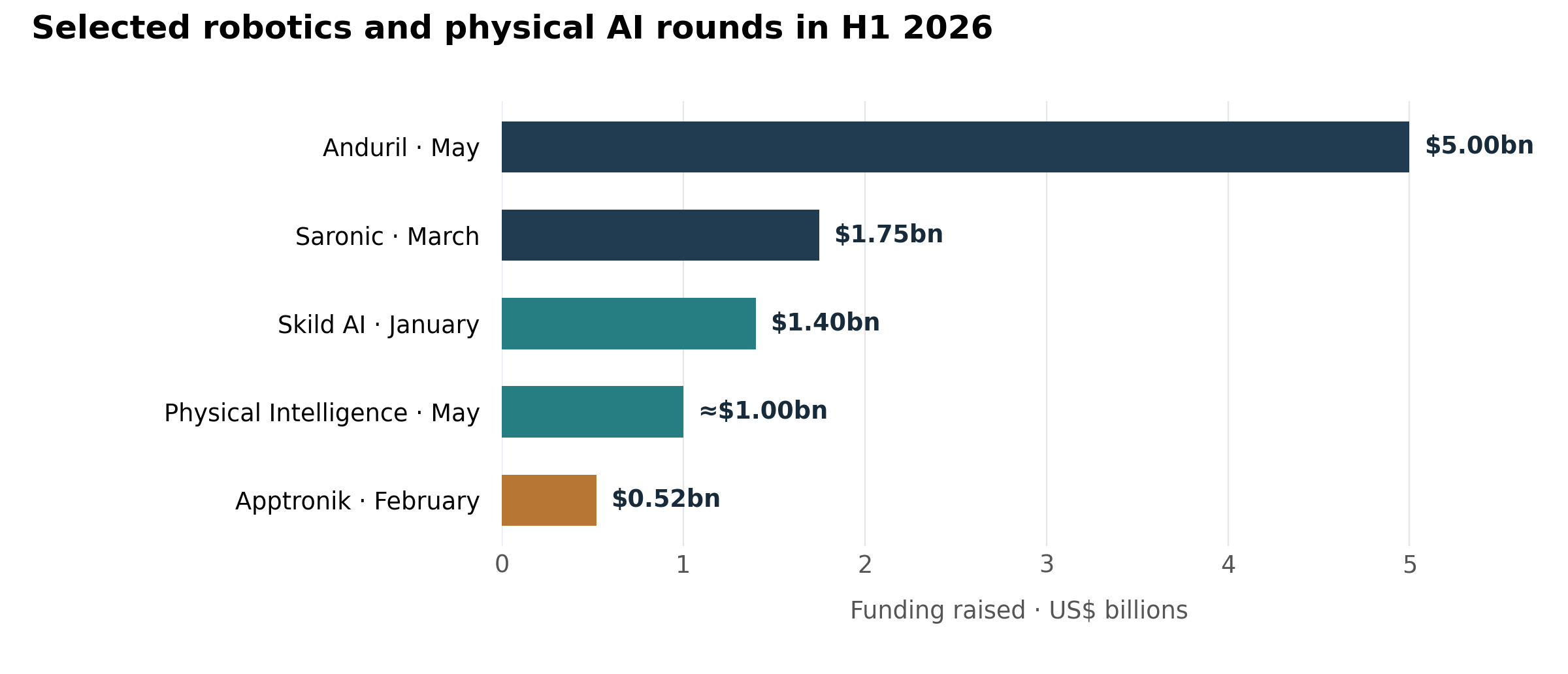
Several large rounds show the breadth of the opportunity. Anduril announced a $5 billion Series H in May 2026, while Saronic announced a $1.75 billion Series D. These businesses connect autonomy with defence and industrial production. Anduril’s Arsenal programme is designed to scale manufacturing; Saronic’s plans include autonomous vessels, fleet software and shipbuilding infrastructure. [2, 3, 14]
That is a different proposition from selling general-purpose robot intelligence. Skild AI raised $1.4 billion in January and explicitly earmarked capital for simulation, data collection, foundational research and deployment. Business Insider separately reports that Physical Intelligence, another developer of robot-control models, raised about $1 billion in May. [1, 4]
Humanoid makers have their own expensive transition to manage. Apptronik’s $520 million February extension round was intended to increase Apollo production, expand commercial and pilot deployments, and build training and data-collection facilities. The $520 million was new funding; the company’s larger $935 million Series A figure also includes money raised in 2025. [5]
Three different routes to a viable business
A useful way to read these announcements is to separate three overlapping business models. An integrated systems company must coordinate hardware, software and production, while securing customers able to absorb its output. A robot-intelligence supplier must make its models useful across machines and prove that each deployment requires less bespoke engineering. An application provider must deliver a particular task at a cost and service level the customer will accept.
Each model creates a different financial burden. Factory construction ties up capital before production reaches scale. Model development consumes money on research, computing and data. Selling automation as a service can reduce a customer’s initial purchase cost, while leaving the provider or its financing partner responsible for funding the machines. A large funding round is meaningful only in relation to the bottleneck it is intended to remove.
Infrastructure investment adds another layer. Andreessen Horowitz’s $1.1 billion Machine Age Fund, announced in August, covers chips, memory, networking, data centres, robotics and home AI appliances. That is capital committed to a fund with a broad remit. It cannot simply be added to startup funding receipts as though every dollar had already reached a robot developer. [12]
Commercial progress needs careful labels
There is tangible evidence that newer robots can perform useful work. BMW said in June 2026 that Figure 02 had supported production of more than 30,000 X3 vehicles over ten months in 2025. Its job was to insert sheet-metal parts for welding. BMW described the completed programme as a pilot and announced a subsequent Figure 03 logistics project. The result demonstrates a defined task inside a production process; it does not establish that a humanoid built complete cars or delivered a disclosed financial return. [9]
Paid deployment is another milestone. GXO’s June 2024 agreement with Agility Robotics followed a proof-of-concept trial and introduced Digit under a multi-year Robots-as-a-Service arrangement. At a SPANX facility, the robots moved totes from mobile robots onto conveyors. The announcement established commercial activity, but did not disclose the contract’s value, customer savings or provider profitability. [10]
Revenue figures also need their definitions attached. In September 2026, Skild AI reported more than 60 paying customers, $100 million in annual recurring revenue and $50 million of revenue recognised since deployment began ten months earlier. Those are company-reported figures. An annualised recurring measure and revenue already recognised answer different questions; neither, by itself, reveals margins, cash collection or customer retention. [8]
For readers assessing progress, the sequence matters: a demonstration shows what may be possible under selected conditions; a production pilot tests performance under operational constraints; a paid contract establishes willingness to pay; renewals and expansion provide stronger evidence of sustained customer value. Companies can advance through these stages at very different speeds.
The economics are decided at the task level
A robot’s purchase price is only the beginning of a useful comparison. A buyer needs to account for installation, workflow changes, maintenance, supervision, energy and downtime. The relevant denominator is accepted output: parts correctly handled, inspections completed or orders processed at the required quality. An inexpensive machine can become costly if people must repeatedly rescue it.
Speed and reliability must be assessed together. A robot that completes a task accurately but misses the production cycle can constrain an entire line. A fast robot that creates rework may shift costs elsewhere. Skild’s own deployment account emphasises these operational trade-offs, including the difficulty of adapting when a customer changes components or processes. [8]
For a professional evaluating a supplier, several questions cut through the presentation. How many productive hours does the system deliver? How frequently does a person intervene, and for how long? Does performance survive a new product mix or a changed layout? What does the full service cost, and who pays when it stops? The answers should come from measured customer operations with clearly defined test conditions.
Established fleets show why software improvements can matter without a new robot shape. When Amazon announced its millionth deployed robot in June 2025, it also introduced DeepFleet, which it said would improve robot travel efficiency by 10%. That claim concerns fleet movement, rather than a 10% reduction in total fulfilment costs. It nevertheless illustrates an attractive possibility: improving the utilisation of machines already installed. [11]
Data can compound but deployment costs can too
One attraction of robot-intelligence businesses is that deployments may generate data that improves subsequent performance. Skild describes learning from simulation, internet videos, teleoperation and customer operations. If those improvements transfer to new tasks, a supplier could spread its research investment across a growing customer base. [4]
The key word is transfer. Experience in one warehouse does not automatically solve a different factory’s handling problem. For investors and buyers, an informative measure would be the engineering effort required to bring each additional site into service. Falling deployment time and support requirements would strengthen the case that the business can scale. Revenue growth accompanied by equally rapid growth in custom engineering would suggest a more labour-intensive model.
Manufacturers face a related test. Building production capacity ahead of demand can shorten delivery times and improve purchasing economics. It can also leave expensive facilities underused. The questions therefore extend from whether a robot works to whether customers order it repeatedly, whether the supply chain can deliver it consistently, and whether servicing it leaves an acceptable margin.
A funding boom with uneven benefits
F-Prime’s State of Robotics 2026 report offers a useful warning against treating the boom as universal. In its dataset covering the Americas, Europe and Israel, funding for humanoids and robot foundation models rose from $2 billion in 2024 to $6.1 billion in 2025. Its deal-size analysis, which excludes rounds below $2.5 million, found that funding growth over the preceding two years was concentrated in rounds above $50 million. Smaller and mid-sized rounds were broadly flat over the past five years. [13]
That concentration can finance the costly work required to commercialise robotics. It also makes the headline total a poor guide to the experience of a typical founder. Well-funded companies may be able to sustain long development programmes; competitors with useful products may still struggle to finance inventory, integration or customer support.
The next evidence worth watching is specific: pilots converting into repeat orders, deployments expanding beyond the first site, less human intervention per completed task, shorter installation times and margins that survive servicing costs. These measures would show whether capital is reducing the practical barriers to adoption.
Robotics can become a much larger industry while producing very uneven investment outcomes. The strongest commercial stories will explain how a machine improves a customer’s operation, what it costs to keep that improvement running, and why the next installation should be easier than the last.
Research notes
Research cut-off 21 October 2026. Funding amounts are in US dollars. The global funding headline is attributed to Business Insider’s reporting of PitchBook data; the underlying dataset was not independently reconciled. The selected rounds are examples, not a complete allocation of the global total. F-Prime uses a separately defined geographic and sector dataset. Company announcements establish stated plans and reported results, not independently audited performance. Analytical judgments are the author’s synthesis of the cited evidence.
Sources
1. Business Insider: Why Silicon Valley VCs are investing billions in robotics and AI (21 October 2026).
2. Anduril: Announces $5B Series H raise (13 May 2026).
3. Saronic: Official newsroom and Series D announcement (2026).
4. Skild AI: Announcing Series C (14 January 2026).
5. Apptronik: Closes over $935 million Series A with new $520 million extension (11 February 2026).
6. International Federation of Robotics: Five million robots now operate in factories globally (24 September 2026).
7. Google DeepMind: Gemini Robotics 1.5 brings AI agents into the physical world (25 September 2025).
8. Skild AI: The hidden pillar of robotics (10 September 2026).
9. BMW Group: Advances the use of Physical AI in production with Figure 03 project in Spartanburg (25 June 2026).
10. GXO: Signs multi-year agreement with Agility Robotics (27 June 2024).
11. Amazon: Launches DeepFleet and deploys its millionth robot (30 June 2025).
12. Andreessen Horowitz: The Machine Age Fund (28 August 2026).
13. F-Prime: State of Robotics 2026 (March 2026; pages 3–6).
14. Anduril: Building Arsenal 1 manufacturing facility in Ohio (16 January 2025).