
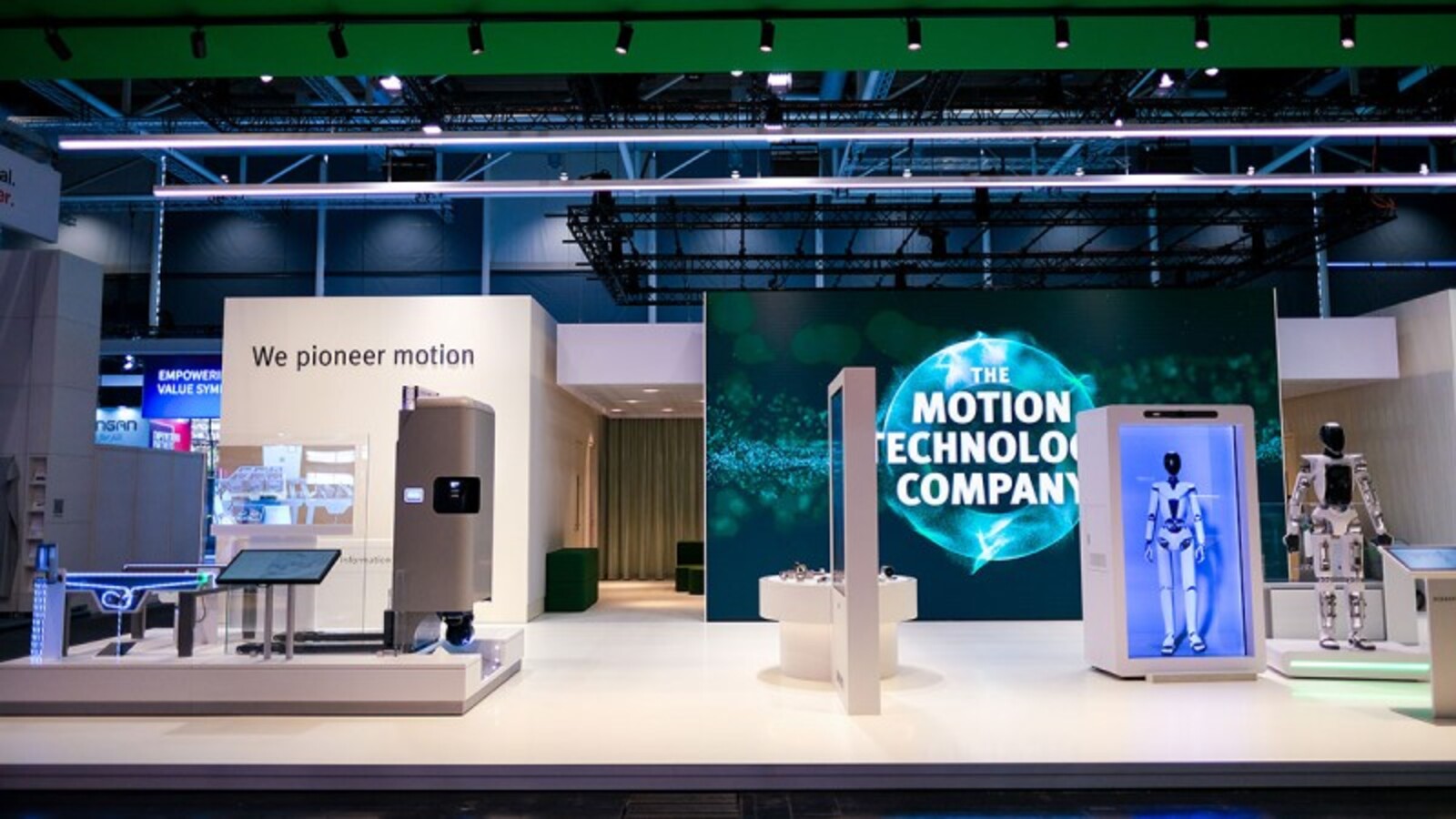
Image: Schaeffler.
Germany’s engineering industry has urged Europe to treat humanoid robotics as a strategic industrial priority, warning that research strength will count for little without the supply chains and production capacity required to manufacture robots at scale.
The VDMA engineering association said on 19 August that humanoid robotics and physical AI should move to the top of the political agenda in Germany and across Europe.
Its intervention came on the day of Unitree Robotics’ extraordinary Shanghai market debut, a conspicuous demonstration of the capital, industrial momentum and political attention gathering around China’s humanoid-robotics sector.
Global humanoid shipments nearly quadrupled to an estimated 19,100 units during the first half of 2026, according to market data cited by Reuters, with Chinese manufacturers supplying the large majority. Those figures measure shipments rather than productive deployments, but they nevertheless reveal the scale at which Chinese manufacturers are beginning to move.
The central problem is scale
Europe does not lack robotics expertise. It has leading industrial-automation companies, precision-component manufacturers, research institutions, machine-vision specialists and systems integrators. The harder question is whether those capabilities can be assembled into a competitive humanoid-robotics industry.
“The crucial challenge lies in scaling,” the VDMA said.
Hartmut Rauen, the association’s deputy executive director, called for a European value chain that includes domestic production of critical components.
That distinction matters. A laboratory can build a sophisticated prototype from globally sourced parts. A durable industrial sector must secure actuators, precision transmissions, sensors, dexterous hands, batteries, computing hardware and manufacturing capacity—then integrate them with reliable control software and after-sales support.
The eventual leaders may therefore be determined less by the most impressive demonstration than by who can repeatedly manufacture, deploy and maintain machines at an economically viable cost.
Europe is not starting from zero
The VDMA’s warning is not simply a reaction to Unitree’s flotation. Earlier in 2026, the association and the German Aerospace Center examined four possible development paths in the Humanoid Robotics 2040 scenario study. Their conclusion was that Europe must accelerate investment and cooperation if its existing engineering strengths are to become industrial leadership.
The association has separately argued that humanoids could form a new class of machinery spanning industry, logistics, care, agriculture and the home. Its broader industrial-AI position stresses the importance of integrating AI with established industrial systems, standards, digital twins and sector-specific data.
The European Commission has reached a similar diagnosis. In July, it described Europe as a leader in robotics research while acknowledging the need to turn scientific capability into industrial strength as AI increasingly moves into physical machines.
The EU’s AI Continent Action Plan aims to mobilise €200 billion for AI and create major computing infrastructure. That programme is much broader than robotics, however. Computing capacity alone does not establish a European supply chain for motors, joints, hands, sensors or complete humanoid systems.
What this means for Britain
Britain is outside the EU’s industrial-policy machinery, but it faces substantially the same strategic question. A UK humanoid industry will depend on access to European components, research partnerships, testing facilities and customers, as well as domestic software and engineering talent.
The British government has begun addressing adoption. Innovate UK launched a competition offering up to £38 million for Robotics Adoption Hubs, alongside up to £2 million for a coordinating body. The aim is to help organisations assess, finance and deploy robotics rather than leave potential users to navigate the market alone.
The Health and Safety Executive is also developing Britain’s first joint industry guidance for collaborative workplace robots. Clear safety rules could become a competitive advantage if they enable companies to deploy new machines with greater confidence.
These are valuable measures, but they address adoption and regulation more directly than the supply-chain challenge identified by the VDMA. Britain must still decide where it intends to compete: complete humanoid platforms, control software, specialist components, safety systems, integration—or some deliberate combination of them.
What a credible strategy would require
A serious European response would need to connect research funding with manufacturing and demand. That means supporting component suppliers as well as headline robot companies, expanding shared testing facilities, establishing credible safety and performance benchmarks and creating routes for promising systems to enter factories, logistics operations and public-service trials.
It would also require scale-up capital. Humanoid robotics is unusually demanding because companies must develop AI, mechanical systems and manufacturing processes simultaneously. A business can possess strong technology and still lose ground if it cannot finance inventory, production tooling, field support and the long testing cycles required by industrial customers.
Public procurement could provide early demand, but only if trials measure useful work rather than publicity. Buyers need evidence on uptime, intervention rates, safety incidents, task-completion performance and total operating cost. Units shipped to laboratories or demonstrations should not be treated as equivalent to robots completing sustained commercial work.
Europe need not reproduce China’s industrial model. Its strengths in precision engineering, workplace safety, machine vision, industrial integration and standards offer another route to relevance. But those strengths must be connected before the emerging market consolidates around platforms and supply chains built elsewhere.
A narrowing window
The VDMA’s intervention changes the terms of the European debate. Humanoid robots are no longer only an emerging research field or a collection of speculative demonstrations. They are becoming an industrial-policy question involving manufacturing sovereignty, critical components, standards, capital and access to operational data.
Europe still possesses much of the knowledge needed to compete. The risk is that it remains a supplier of excellent parts and research while other regions control the finished platforms, production volumes and customer relationships.
For Britain and the EU alike, the next stage will be measured not by how many humanoids appear at exhibitions, but by whether European companies can build dependable machines, manufacture them competitively and place them into work that customers will pay for.
Read Robot Harbour’s UK and European robotics coverage, our analysis of Unitree’s Shanghai listing, and our continuing coverage of robotics regulation and safety.