
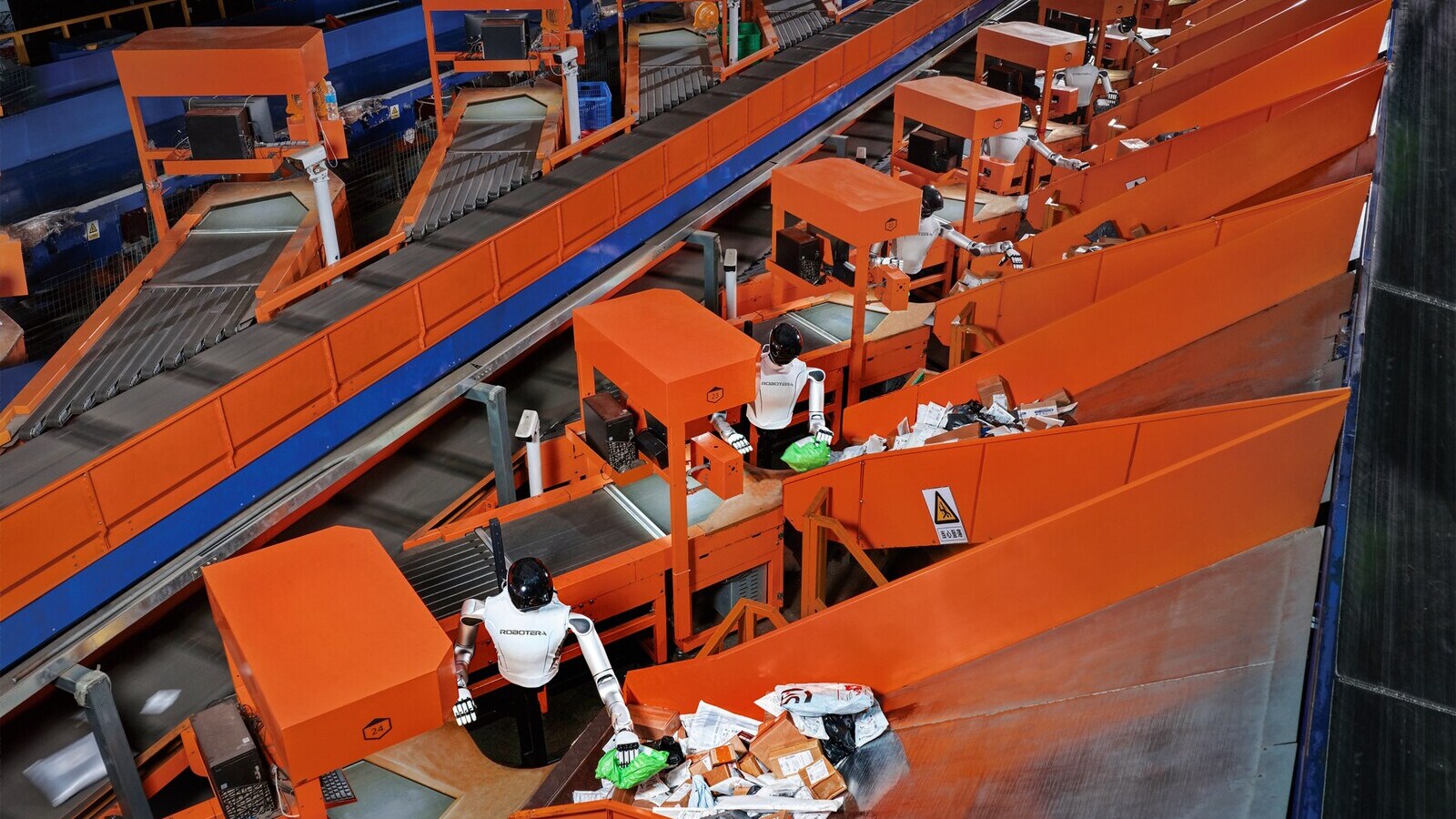
Image: ROBOTERA / PR Newswire.
Chinese robot makers arrived at the 2026 World Robot Conference with the familiar displays of dancing, fighting and acrobatic machines. More consequentially, several companies also supplied evidence that robots are beginning to perform narrow jobs in warehouses, electronics factories and private homes.
The distinction matters. A humanoid completing a rehearsed exhibition routine demonstrates engineering capability, but it does not establish that the machine can work reliably for hours, recover from mistakes or produce an economic return.
At the conference, which opened in Beijing on 19 August, more than 300 exhibitors presented over 2,000 exhibits and more than 150 announced product launches. The most important demonstrations were not necessarily the most spectacular. They were the ones connected to identifiable workplaces and continuing trials.
Reporting from the event by Reuters provides the clearest current picture of where some Chinese robots are actually being used—and where the evidence remains incomplete.
Robotera reports a fleet beyond the single-robot pilot
Robotera demonstrated a humanoid torso mounted on a wheeled, tripod-style base sorting parcels at its conference stand. A company representative told Reuters that more than 100 parcel-sorting robots were operating in 15 warehouses across China.
The company also said its software had powered robots at China Post logistics facilities since 2025. If accurately reported, that places the programme beyond the familiar one-machine pilot and into a limited fleet deployment.
There is an important qualification. The system shown in Beijing was not a conventional bipedal humanoid. Wheels make sense in a flat warehouse because they are generally more stable and energy-efficient than legs. Its form also illustrates how loosely the industry sometimes uses the word “humanoid”.
Robotera has not published independently verified figures for uptime, intervention rates, total parcels processed or operating cost. More than 100 deployed systems is meaningful evidence of activity, but it is not yet enough to establish superior productivity or a proven return on investment.
DexForce reports phone-packing at a Lens Technology factory
DexForce demonstrated humanoid robots placing mobile phones into boxes on an assembly line. According to company official Nicole Yang, the machines have performed the task at a Lens Technology factory since early 2026.
Lens Technology supplies touchscreen glass and other components to major technology companies, including Apple and Huawei. That makes the claimed deployment more significant than a laboratory experiment: the robots are associated with an established electronics-production environment.
DexForce says its machines can operate with millimetre-level accuracy and recognise and correct placement errors. Those capabilities would be valuable for repetitive packaging work, where products arrive in predictable positions but occasional misalignment still has to be handled.
The disclosed evidence remains limited, however. DexForce has not identified the number of deployed robots, their uptime, the frequency of human assistance or whether their cost compares favourably with conventional industrial automation. Packing a phone in a structured workspace is also a far narrower problem than operating as a general-purpose factory worker.
Leju claims active use in China and Europe
Leju Robotics showed robots moving and sorting crates and smaller objects. Zhang Dapeng, the company’s assistant vice-president, told Reuters that Leju machines were already moving boxes and loading components in Chinese automotive plants and factories in Europe.
This is the most direct European connection among the deployments disclosed in Beijing. It suggests that Chinese humanoid systems are not only being developed for their domestic market but are beginning to enter European industrial environments.
Yet the claim currently lacks the operational detail required for a firm assessment. Leju did not name the European customers, disclose the number of robots involved or provide information about deployment duration, safety performance, human supervision or productivity.
For Robot Harbour, the correct description is therefore a reported European factory deployment—not evidence of widespread European adoption.
X Square shows how far home robots still have to travel
X Square Robot is testing robots in hundreds of homes during 2026, according to co-founder Yang Qian. The company intends to move towards gradual commercialisation in 2027.
The scale of the test pool sounds substantial, but its duration provides a more revealing measure of maturity: Reuters reported that X Square’s longest completed home deployment had lasted only one month.
Homes are significantly less predictable than warehouses. Furniture moves, objects vary, people interrupt tasks and every household presents a different layout. A robot that works during a controlled exhibition therefore faces a much harder challenge when left in an ordinary home for weeks.
In an announcement released during the conference, X Square also said it had placed robots in homes from May and had partnered with 58.com to offer paid domestic-cleaning services in China. The company did not disclose completion rates, intervention levels or customer-retention data for those services.
X Square separately reported that its WALL-B parcel-sorting system handled 1,816 parcels an hour with accuracy above 98% during a livestreamed test. That system used industrial robot arms rather than a mobile humanoid. It is relevant evidence of the company’s embodied-AI software, but it should not be presented as proof that its household robots have reached the same performance level.
Deployment is not the same as commercial maturity
Together, the four cases show genuine movement from performance towards work. They do not show that general-purpose humanoids have reached mass adoption.
- Robotera has disclosed the largest identifiable fleet, but not its economics or operating reliability.
- DexForce has connected its robot to a real production task, but supplied no deployment scale.
- Leju has reported factory use in Europe, but has not identified the customers or supplied measurable results.
- X Square is collecting experience in real homes, but its longest reported deployment remains short.
The wider market requires similar caution. One estimate cited by Reuters placed global humanoid shipments at 19,100 units during the first half of 2026. Units shipped to research laboratories, exhibitions and robot-training centres do not necessarily represent productive machines working for paying customers.
Robotics analyst Georg Stieler estimates that between 50% and 70% of humanoids produced during 2026 could go into “data factories”, where the machines generate training data rather than perform revenue-producing work.
Economics remain another barrier. A commercial analysis cited by Reuters estimated that an industrial humanoid would need to cost approximately RMB 160,000, including maintenance, to recover its cost within two years against a worker earning RMB 80,000 annually. Berlin-based research institute MERICS estimates that current machines more commonly cost between RMB 300,000 and RMB 500,000.
Those figures will vary by task, location and utilisation. They nevertheless explain why a robot’s price, uptime and maintenance requirements matter more commercially than its ability to complete a backflip.
Why Britain and Europe should pay attention
The Leju disclosure is an early indication that Chinese humanoid companies are seeking operational experience inside European industry. That experience creates data: every completed task and recovered error can improve the next software release.
Europe retains substantial capabilities in industrial automation, machine safety, sensors, actuators and production engineering. Its central challenge is turning those strengths into scalable robot platforms and real deployments.
Germany’s VDMA engineering federation made that concern explicit on 19 August, calling for humanoid robotics and physical AI to move higher on Europe’s political agenda and for a resilient regional supply chain for critical components. The organisation identified scaling as the decisive challenge.
British companies are also entering the industrial race. London-based Humanoid plans an initial deployment at two Schaeffler sites in Germany between December 2026 and June 2027, as part of a longer-term plan that could place between 1,000 and 2,000 robots across the manufacturer’s global operations by 2032. That remains a planned rollout rather than an active deployment, but it offers an important European comparison.
The next benchmark must be operational evidence
The honest conclusion from Beijing is not that the general-purpose humanoid worker has arrived. It is that a small group of robot makers is beginning to cross the boundary between staged demonstration and narrowly defined work.
The next stage will require more transparent evidence: operating hours, task-completion rates, human interventions, safety incidents, maintenance costs and measurable returns for customers.
Until companies publish those figures, the strongest commercial signal will not be the most impressive video. It will be a robot that quietly completes the same useful task, throughout a working shift, at a cost its customer can justify.
Sources
- Reuters: China robot makers seek to turn humanoid hype into useful work, 19 August 2026.
- Reuters: Beyond marathons and backflips, China’s robots face a commercial test, 18 August 2026.
- Reuters: Chinese companies to watch at the World Robot Conference, 20 August 2026.
- X Square Robot: World Robot Conference deployment announcement, 19 August 2026.
- Reuters: VDMA calls for a European humanoid-robotics strategy, 19 August 2026.