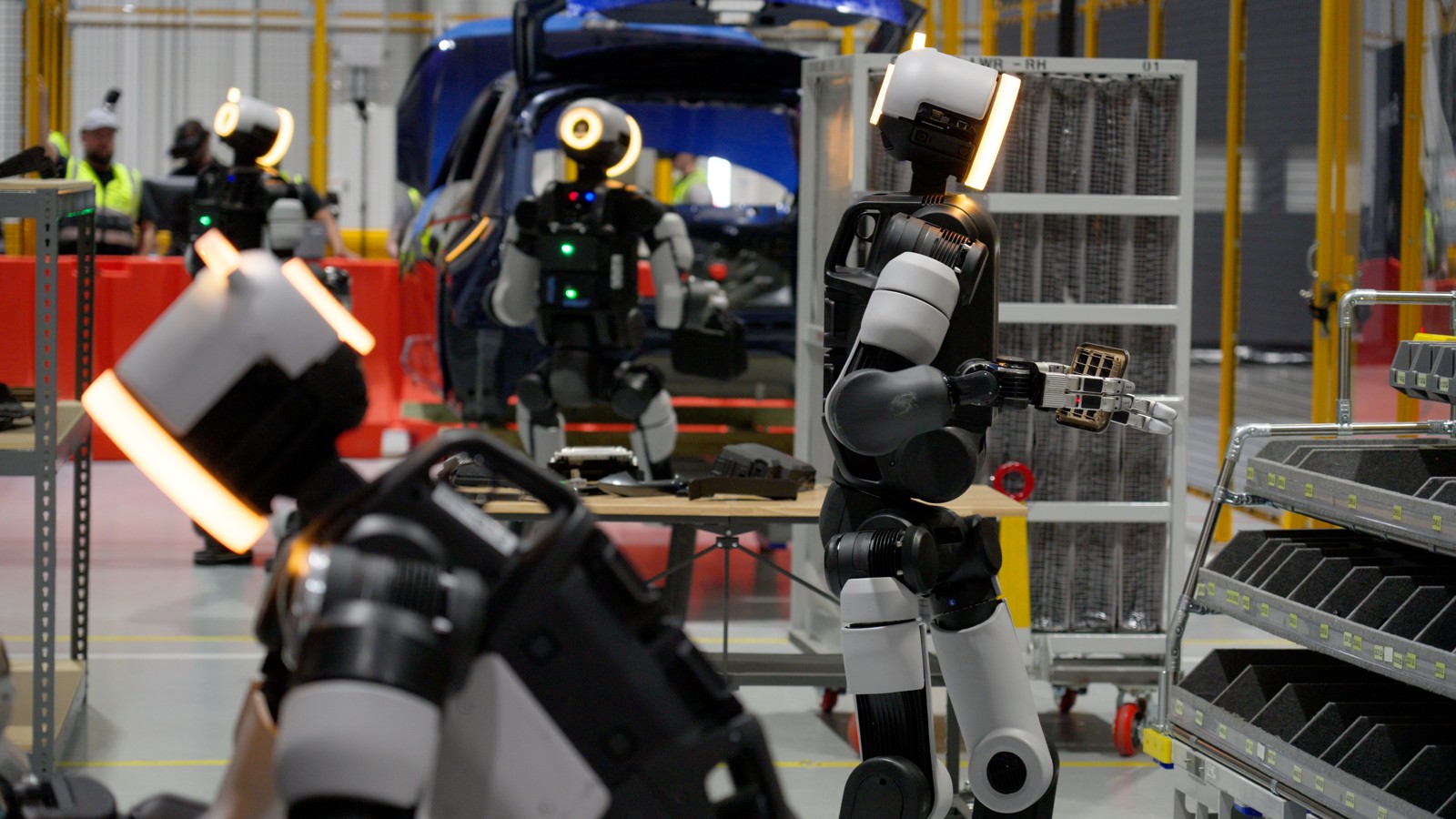
Atlas robots in a manufacturing setting. Photo Credit: Boston Dynamics.
Boston Dynamics has appointed former Amazon AI executive Rohit Prasad as chief executive, bringing a leader with experience of large-scale software products to its effort to commercialise intelligent robots.
The appointment was announced on 6 October and takes effect on 7 October. Prasad spent 12 years at Amazon, helping build Alexa and later leading development of its Nova foundation models. His anticipated appointment to Boston Dynamics’ board remains subject to approval.
The choice suggests that Boston Dynamics sees AI product development as central to its next stage. Translating that experience into robotics will also require machines that customers can maintain and operate reliably over repeated shifts.
Atlas training moves closer to factory operations
The leadership change follows the factory-training programme we reported in September, including the opening of Boston Dynamics’ Robotics Metaplant Application Center at Hyundai Motor Group’s manufacturing campus near Savannah, Georgia.
Atlas robots are being trained there for tasks including arranging automotive parts in the sequence required for assembly. Boston Dynamics says the centre will move into premises approximately ten times larger in 2027, with component assembly among the applications planned by 2030.
The scale of Hyundai’s ambitions is substantial: the group plans to deploy 25,000 Atlas robots across Hyundai Motor and Kia plants over the next few years, alongside a US facility capable of making 30,000 robots annually. These are deployment and capacity plans; the operating training centre does not establish that either scale has been achieved.
Dexterity and manufacturing meet
The hand design we covered last week shows another part of the commercial challenge. Boston Dynamics’ new Atlas hand design uses four fingers and 13 degrees of freedom, increasing the range of movements available for manipulating objects. Pressure sensors in the palm and fingertips provide information about contact.
The company says omitting a fifth finger reduces the number of actuators, cutting complexity, cost and potential failure points. It has designed the hand around tasks such as repositioning an object within the grasp and operating tools with triggers.
Those choices underline the job ahead for Prasad. Better learning systems can broaden the tasks a robot performs, but the business case also depends on how often it needs human assistance, how quickly faults can be fixed and how much productive work it delivers. Factory training and more dexterous hands are steps towards answering those questions, rather than evidence that deployment economics are settled.