
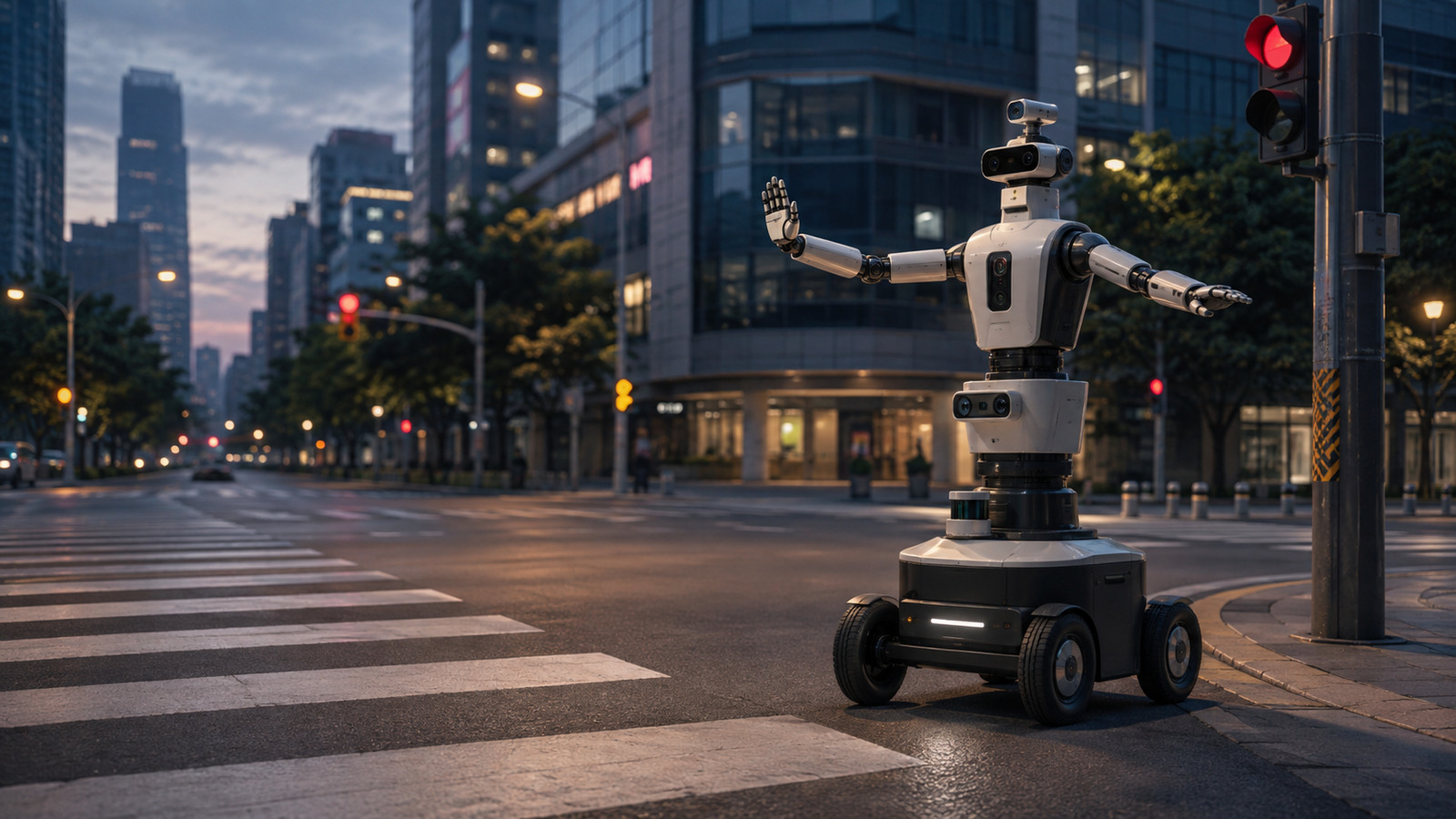
Editorial illustration generated for Robot Harbour; not a documentary image of the SUPCON T2.
SUPCON Information says nearly 50 human-shaped traffic robots are now operating across about eight Chinese cities, including 15 deployed in Hangzhou since May. The machines can direct traffic, recognise certain apparent violations and issue spoken warnings. They have no arrest authority; the reviewed sources describe warnings and referral into a human-run police platform. They are not walking humanoids.
The distinction matters. The T2 resembles a uniformed traffic officer from the waist up, but moves on a four-wheel chassis rather than two legs. Its significance lies not in imitating human locomotion, but in placing cameras, radar, visual-recognition software and a mobile public interface into sustained street-level service.
What the T2 does in Hangzhou
The T2 stands 1.88 metres tall and weighs 98 kilograms. According to SUPCON and a Reuters field report published on 20 August, its cameras, radar and onboard computing can identify riders without helmets, e-bikes carrying passengers, vehicles stopping beyond marked lines and pedestrians crossing against traffic signals.
Seven-jointed arms reproduce standard traffic-police gestures in synchronisation with the lights. The robot can also answer questions about directions, parking and traffic rules, while an emergency function connects members of the public with local police.
SUPCON says the units operate autonomously between preset positions from 7 a.m. until 6 p.m. They are not remotely driven during ordinary movement, although police teams can monitor and dispatch them through a central platform.
People’s Daily reported on 26 June that 15 traffic-management robots had been deployed since May around West Lake, commercial districts and major roads in Hangzhou. The same report said that information concerning a suspected violation may be archived and passed to a police early-warning centre if a person does not respond after repeated reminders.
A deployment—not an autonomous police force
Nearly 50 units working across eight cities constitutes a meaningful public-space deployment. It should not be described as autonomous policing.
The robots have no arrest authority. The reviewed sources describe their present role as a mobile traffic-management and public-information system: they observe, classify, communicate and refer information into a human-controlled police platform.
That is still a consequential use of robotics. Unlike a fixed exhibition demonstration, the T2 must move through live streets, operate around unpredictable road users, communicate clearly and perform consistently in changing light and weather.
SUPCON expects deployments to approach 200 robots by the end of 2026. That remains a company forecast rather than a completed rollout.
The performance figures need independent testing
SUPCON says its Hangzhou robots have issued more than 170,000 warnings and helped reduce monthly instances of helmetless riding and vehicles crossing stop lines by more than 40 percent. It also claims violation-recognition accuracy above 95 percent.
Those figures have not been independently verified. Hangzhou traffic police did not respond to Reuters’ request for confirmation, and no public technical audit accompanies the claims.
An overall accuracy percentage would not, by itself, establish dependable performance. A proper assessment would need to disclose false-positive and false-negative rates for each type of alleged violation, performance in rain and strong sunlight, the test population, the period measured and the extent of human review.
SUPCON acknowledges that cameras and radar can be affected by weather, temperature extremes and difficult lighting. Those limitations matter when a system is addressing named or visibly identifiable people in public.
Surveillance questions arise even without facial recognition
The available evidence does not establish that the T2 performs facial recognition or attempts to identify people biometrically. Robot Harbour therefore does not describe it as a facial-recognition system.
Its operation nevertheless raises ordinary but important surveillance questions. Public information does not yet explain precisely what imagery or metadata is retained, how long it is stored, who may access it, whether records are linked with identities or vehicle registrations, and what human review occurs before information is escalated.
There is also a question of responsibility. A human-shaped machine dressed to resemble an officer carries visible authority, even when it can only issue a reminder. If the system wrongly singles someone out, the public needs a clear route to challenge the error and a named authority responsible for correcting it.
Independent evaluation should therefore cover more than detection accuracy. It should examine data minimisation, retention, cybersecurity, audit logs, operator access, bias, accessibility and the consequences of a false alert.
What a UK or European deployment would face
A similar system would not arrive in Britain or Europe as an ordinary piece of street furniture. Its legal position would depend on what its cameras analyse, whether people are identified, how information is retained and whether the output contributes to an enforcement decision.
In the United Kingdom, police processing of personal information for law-enforcement purposes is governed principally by Part 3 of the Data Protection Act 2018. Current Information Commissioner’s Office guidance says a data-protection impact assessment must be completed before processing likely to create a high risk to people’s rights, expressly including new surveillance technologies.
A British operator would need to demonstrate necessity and proportionality, define the system’s purpose, limit collection and retention, secure the data and preserve meaningful human oversight. Giving the cameras a robot body would not reduce those obligations.
In the European Union, camera-based traffic guidance is not automatically prohibited. If a future version performed real-time remote biometric identification for law-enforcement purposes, however, the EU AI Act permits that practice only within narrow exceptions and strict authorisation conditions. The Act’s broader high-risk rules for specified law-enforcement uses are currently scheduled to apply from 2 December 2027, while existing data-protection and national policing rules continue to apply.
AiMOGA executive Zhang Guibing told Reuters that exporting police robots would require integration with local law-enforcement systems, certification and compliance with data-protection requirements. That is an important commercial reality: exportability depends on governance as much as hardware.
What Robot Harbour will watch next
The T2 is evidence that human-shaped service robots are moving into persistent public roles, but the most important evidence is still missing.
Robot Harbour will watch for independently verified deployment results, published retention and human-review policies, documented false-alert rates, third-party privacy or security assessments and confirmation of whether the planned expansion to 200 units occurs.
The real test is not whether a robot can wave traffic through an intersection. It is whether a public authority can show that the system is effective, proportionate, contestable and accountable when it makes a mistake.
For related coverage, see Robot Harbour’s Regulation and Safety section and its analysis of robotics developments affecting the UK and Europe.
Last verified: 20 August 2026. Deployment and performance claims remain attributed to SUPCON unless independently confirmed.
Sources
- Reuters — China puts robocops on traffic duty, minus the arrest powers, 20 August 2026
- SUPCON Information — official T2 application report, 27 July 2026
- People’s Daily — Hangzhou traffic-robot operations, 26 June 2026
- UK Information Commissioner’s Office — law-enforcement DPIA guidance
- EUR-Lex — consolidated EU Artificial Intelligence Act