Robot Harbour / Robot profile
HMND 01 Alpha Wheeled
Source-backed company and product intelligence, reviewed from a UK and European perspective.
- Manufacturer
- Humanoid
- Status
- Pilot or limited deployment
- Price
- Not verified
- UK
- Announced
- Europe
- Pilot or limited deployment
- Last verified
- 2026-08-06
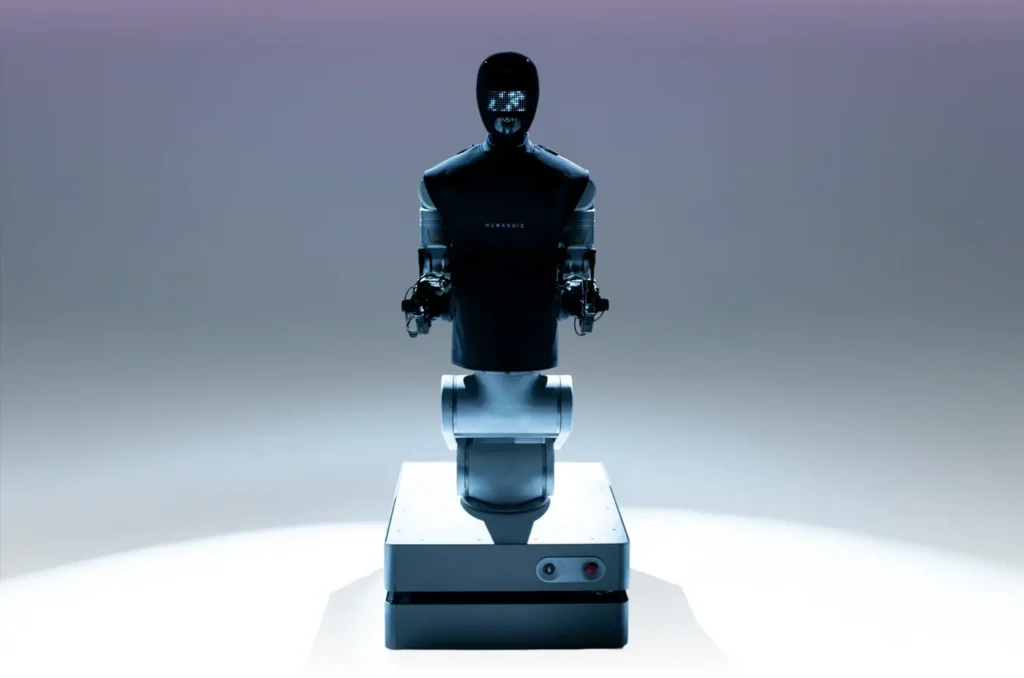
HMND 01 Alpha Wheeled is Humanoid’s industrial humanoid platform, combining two arms and interchangeable end effectors with an omnidirectional mobile base.
Design and intended work
The wheeled architecture prioritises stability, runtime and movement across flat industrial floors rather than human-like walking. Humanoid is initially targeting intralogistics, tote and box handling, machine feeding and other repetitive manufacturing or warehouse workflows.
The manufacturer lists a height of 220 cm, weight of 300 kg, 29 degrees of freedom, a maximum speed of 2 m/s, average runtime of four hours and a payload of up to 15 kg. The end-effector options are a 12-degree-of-freedom five-finger hand or a simpler parallel gripper.
Perception and control
The sensor package includes RGB and depth cameras, force-torque sensing and haptic feedback. The robot runs Humanoid’s KinetIQ stack on NVIDIA compute for motion control, learned manipulation, task execution and fleet coordination.
Deployment status
HMND 01 has completed proof-of-concept work with Bosch, Siemens, SAP, Schaeffler and other industrial partners. Humanoid’s agreement with Schaeffler targets phased deployment beginning in Germany in December 2026, while its financing announcement targets beta roll-outs in the fourth quarter of 2026.
Robot Harbour therefore records the system as pilot-stage in Europe rather than generally available. The company offers an early-access route, but has not published a list price or standard delivery schedule.
Evidence and limits
At Siemens’ Erlangen electronics factory, the robot reportedly met trial targets of 60 tote moves per hour, more than eight hours of uptime and above 90% autonomous pick-and-place success. These figures come from the participating companies and do not yet establish performance across unrelated facilities, tasks or long-duration fleets.