
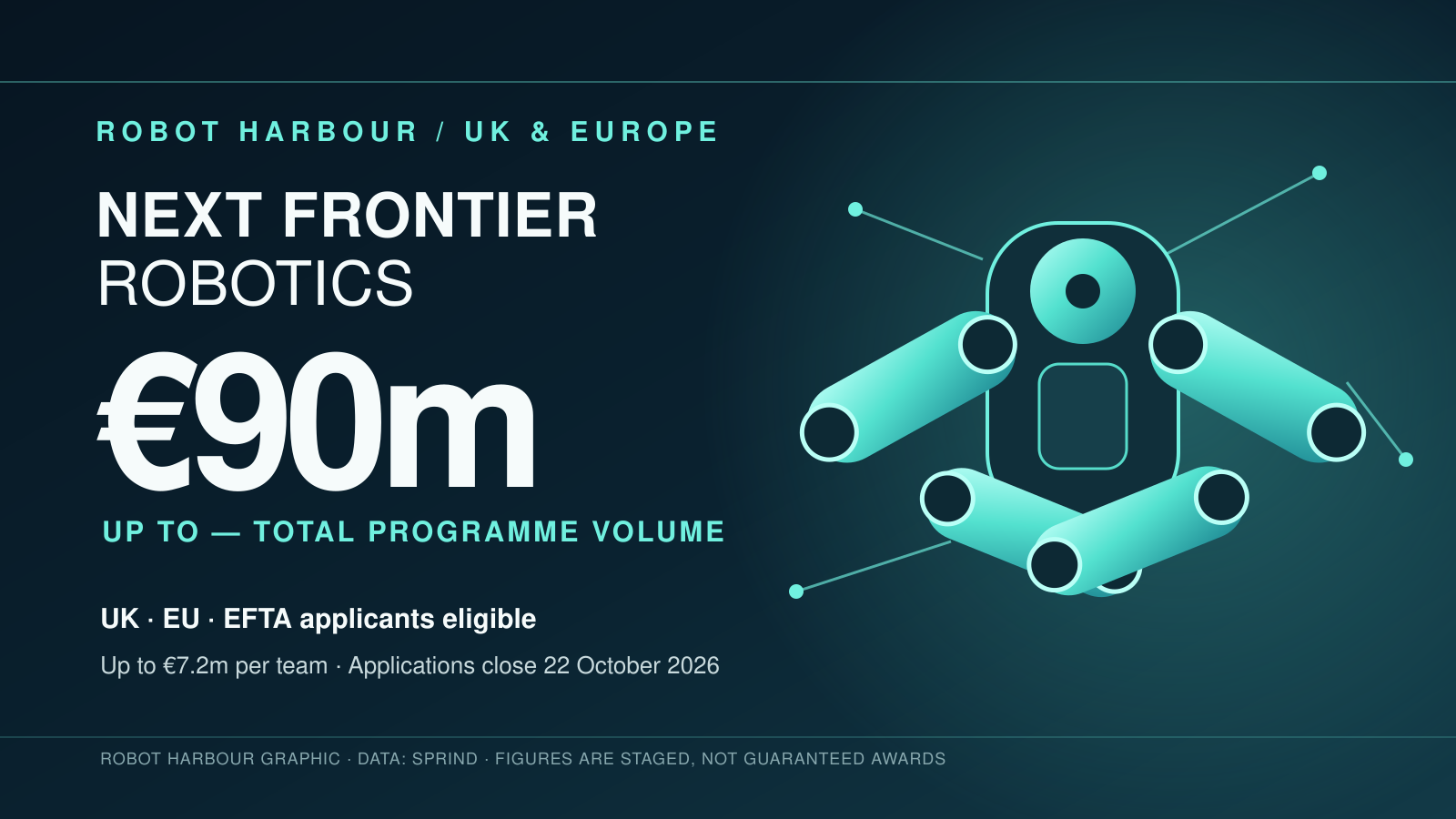
Graphic: SPRIND’s Next Frontier Robotics Challenge has a total programme volume of up to €90 million, with as much as €7.2 million available per team through staged contracts. Robot Harbour graphic; data: SPRIND.
British robotics companies, researchers and prospective founders can apply for Germany’s Next Frontier Robotics Challenge, a staged programme with a total volume of up to €90 million.
SPRIND, Germany’s Federal Agency for Breakthrough Innovation, opened applications on 17 August. The deadline is 22 October 2026 at 18:00 CEST—17:00 BST in the UK.
Selected teams can receive fixed-price contracts worth up to €7.2 million over four competitive stages and 36 months. The programme is intended to move multipurpose robots and critical hardware from laboratory demonstrations towards interoperable systems tested in real operating environments.
UK applicants are explicitly eligible
The official rules include applicants based in the United Kingdom alongside those in the European Union and European Free Trade Association.
Individuals, teams, universities, research institutions, start-ups and established companies can apply. An incorporated applicant must be headquartered in the EU, EFTA or UK and have at least 50 per cent of its equity held within those regions. Team members and collaborators can be located elsewhere.
Applicants do not need to have formed a company before applying, but SPRIND expects teams to pursue incorporation—ideally before the challenge begins—and to show a credible route towards a self-sustaining business.
The explicit inclusion of Britain is unusually useful after Brexit. It gives UK robotics teams access to a large European technology-transfer programme without requiring them to relocate into the EU, provided they satisfy the ownership and location conditions.
Two tracks: complete platforms and components
The challenge is divided into two complementary tracks.
Integrated Platforms is for complete multipurpose robotic systems able to perform complex commercial tasks. The scope can include humanoid, quadruped or wheeled platforms; applicants are not required to adopt a human form.
Hardware Components covers enabling technologies such as grippers, sensors, actuators, joints and tactile systems that can deliver a measurable improvement over the state of the art.
The first stages test each approach separately in the laboratory and then in the real world. Later stages focus on integrating components into external systems and making different systems work together. SPRIND says it wants participants to collaborate on integration standards rather than build another set of closed, incompatible platforms.
The main target areas are terrestrial applications in settings such as logistics, care support and construction. A pure software proposal is not enough: platform teams must validate their work on physical hardware.
How the funding is staged
The headline figures require careful interpretation. Up to €90 million is the total programme volume, not a single prize. The maximum of €7.2 million per team is available only through progression across all four stages.
| Stage | Integrated Platforms | Hardware Components |
|---|---|---|
| 1 | Up to €1.0m | Up to €2.4m |
| 2 | Up to €1.0m | Up to €2.2m |
| 3 | Up to €2.2m | Up to €1.6m |
| 4 | Up to €3.0m | Up to €1.0m |
Up to six platform teams and nine component teams are expected to begin. A maximum of three teams in each track can advance to the final stage. Funding is therefore competitive and progressively concentrated.
SPRIND describes the support as individual fixed-price contracts based on each team’s cost estimate, not a conventional research grant. Challenge work cannot be financed in parallel by other public funding, and teams applying to both tracks must submit separate applications.
Why the programme matters for Europe
Europe’s robotics problem is not a lack of research or industrial engineering. It is the difficulty of combining components, software, finance, customers and manufacturing quickly enough to create scalable products.
Next Frontier Robotics addresses that gap directly. It gives platform builders and component specialists a shared timetable, requires physical testing and makes interoperability part of the later-stage assessment. SPRIND also offers venture-development support and connections to prospective customers and investors.
That design matters for British teams. A UK developer could enter with a complete platform, a novel joint, tactile sensor or gripper, then build technical and commercial relationships with European participants without surrendering its British base.
The programme should not, however, be described as a humanoid subsidy. Its scope is deliberately broader, and the strongest application may use a wheeled or quadrupedal platform—or another non-humanoid multipurpose form—if it demonstrates a genuine performance leap and a credible route to market.
What applicants need to do
- Choose either Integrated Platforms or Hardware Components—or submit a separate application to each.
- Define a measurable advance over the current state of the art.
- Identify a specific first customer and a commercially relevant use case.
- Set out a physical test or benchmark that can demonstrate the claimed improvement.
- Submit by 22 October 2026 at 18:00 CEST, equivalent to 17:00 BST.
SPRIND will hold information webinars on 3 September and 1 October. British teams considering an application should review the full participation agreement and intellectual-property provisions, not rely on the headline funding figure alone.
The UK’s inclusion makes this a substantive European opportunity rather than a story about funding elsewhere. Whether it produces a durable robotics ecosystem will depend on which teams advance, how the systems perform in real environments and whether customers continue after the supported period.
For the wider policy context, read Robot Harbour’s analysis of Europe’s humanoid-robotics strategy debate.
Sources
- SPRIND: official Next Frontier Robotics challenge, rules and FAQ
- SPRIND: official application portal
- Rafael Laguna de la Vera, SPRIND: programme volume statement
- Robotics Institute Germany: challenge summary, 21 August 2026
Last verified: 23 August 2026.