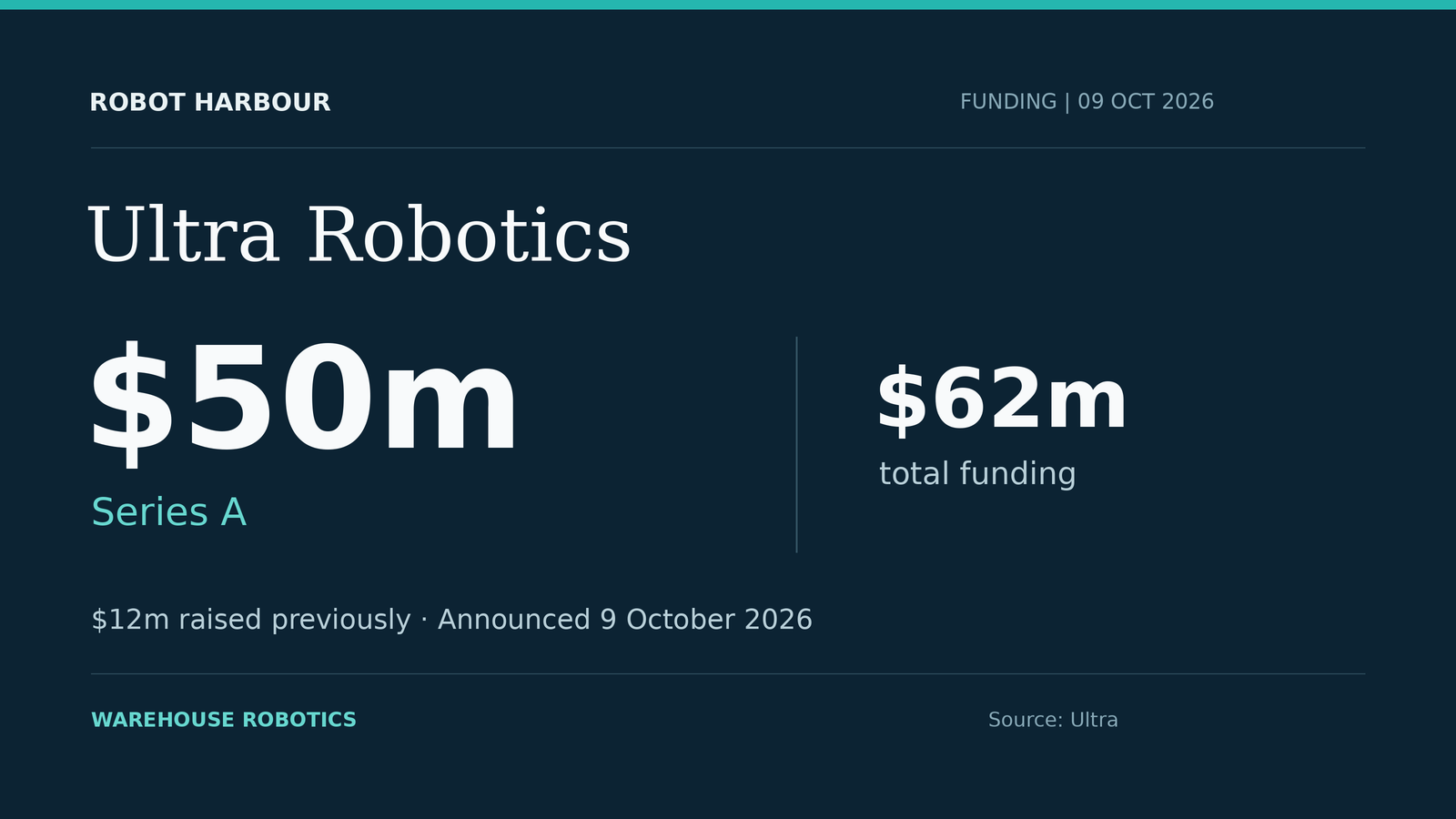
Ultra has raised a $50m Series A to expand its warehouse robotics business, taking total disclosed funding to $62m. The US company puts installation, productive warehouse work and continuing support at the centre of its commercial pitch.
The round, announced on 9 October, was led by Framework Ventures, according to Ultra’s announcement. The $62m headline includes $12m raised previously; it is not the size of the new Series A. SiliconANGLE reports that the earlier seed financing came from Y Combinator and NextView Ventures.
A warehouse worker that stays at its station
Ultra’s OP1 is a dual-arm robot designed for work such as packing orders, sorting and kitting. It operates from a stationary work cell rather than walking around a warehouse. The company’s product material shows deployments in several US locations and describes integration with existing packing equipment.
That choice of form matters commercially. A robot assigned to a defined workstation can be assessed against a specific workflow: how many correct orders it completes, how often it needs help and what happens when it stops. Its value depends on the entire operation, including replenishing materials and handling exceptions.
Highline Commerce, an early customer and development partner, says robots fulfil up to 30% of its daily orders. That gives Ultra a named operating reference, although the figure is customer-reported and does not establish performance across Ultra’s fleet.
Autonomy still includes people
Ultra’s relationship with Physical Intelligence predates the funding announcement. In a technical account published on 24 February 2026, Ultra described using the company’s robot foundation models to pack live customer orders, with remote human intervention when needed.
An accompanying demonstration reported 96.4% autonomy over a full shift. This is a result from that reported run, not independently verified fleet-wide uptime or a guarantee of unattended operation. The publication does not establish this as an OP1-specific result.
The distinction is central to the economics. A high task-success rate can still require staff to supervise, recover failed attempts and keep a work cell supplied. Customers need to understand both productive throughput and the labour that supports it.
The service model is the business test
Fortune reports that Ultra leases robots to warehouses under a monthly service model. Ultra’s own customer enquiry page offers a three-month trial, with a longer-term commitment dependent on demonstrating results. Public contract pricing is not provided.
For operators, that shifts attention from the purchase price to the agreement: deployment charges, support coverage, recovery times, intervention costs and responsibility for maintenance. For robotics suppliers, it makes reliable field support part of the product. Funding alone does not establish whether those services can be delivered profitably at scale.
What it means for Britain
The sources reviewed identify no confirmed UK or European launch date, local price, distributor or authorised service programme as of 10 October 2026. Ultra is therefore a company to track for its deployment model, rather than a confirmed British procurement option.
A future UK opportunity would depend on more than importing the hardware. Buyers and potential service partners would need evidence of sustained customer performance, a suitable local configuration, conformity documentation, diagnostic access and dependable parts supply.
Explore our Ultra company profile and OP1 robot profile. For context, read our Physical AI guide, which explains the models connecting perception, decisions and robotic action.
Reporting is based on Ultra’s public materials, Highline Commerce’s customer account, Physical Intelligence’s technical publication and the linked funding reports. Performance figures are attributed claims. Graphic: Robot Harbour.