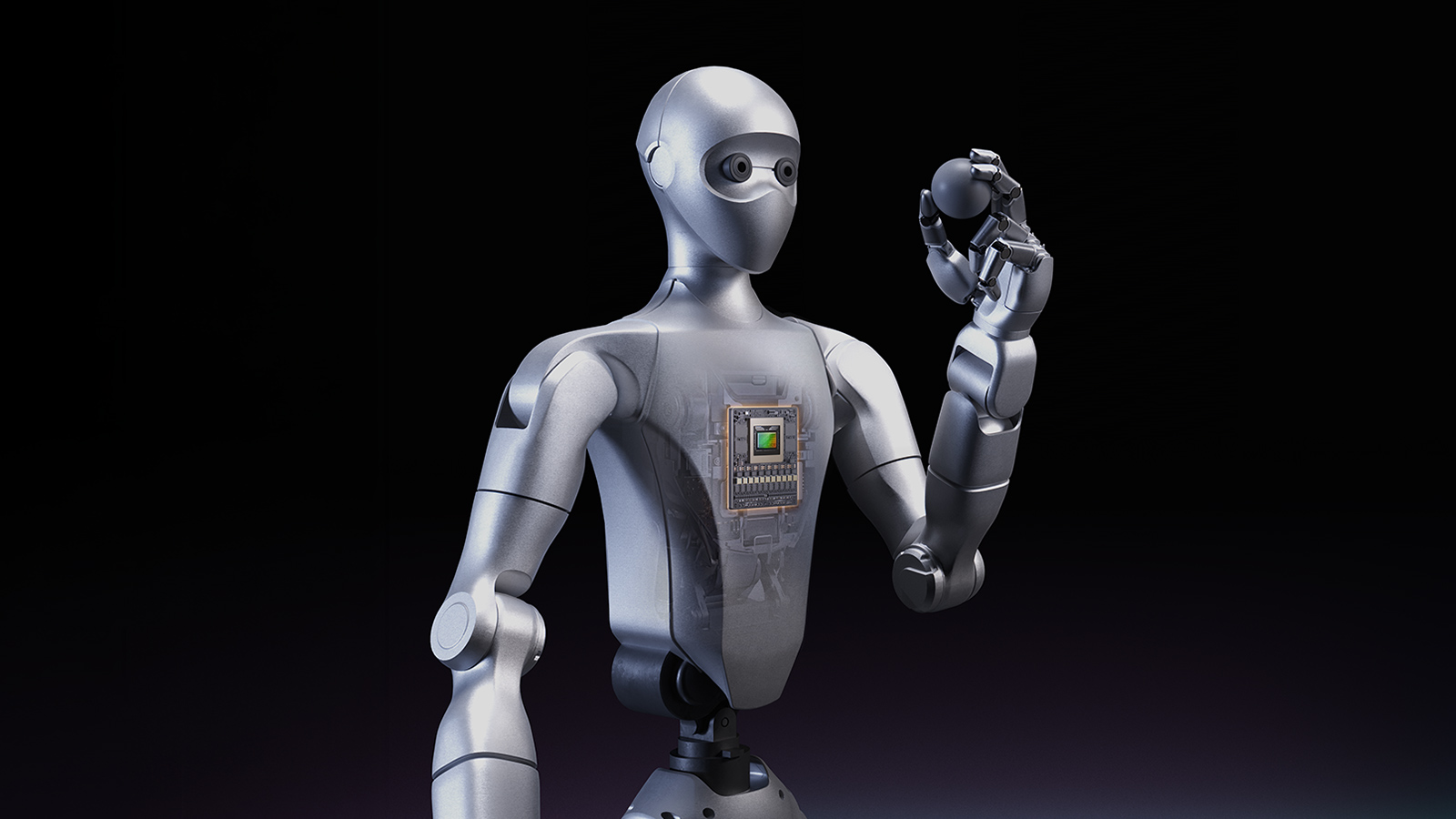
Physical AI is the layer that lets machines perceive, reason about and act in the real world. It is not a new name for every AI system attached to a robot: the useful distinction is whether intelligence changes physical behaviour.
From digital answers to physical action
A language model can explain how to pick up a cup. A physical-AI system has to identify the cup through sensors, understand where it is, choose a safe grasp, generate movement, react if the cup slips and know whether the task succeeded. Errors no longer remain on a screen; they can move machinery, damage property or injure people.
That is why Robot Harbour treats physical AI as a robotics topic rather than a general-AI category. Coverage will focus on models, software, data, simulation and compute that materially affect robot capability.
The four layers that matter
1. Perception
Cameras, force sensors, lidar, microphones and joint data describe the world and the robot’s own state. Models turn those signals into an understanding of objects, people, spaces and motion.
2. Reasoning and planning
An embodied-reasoning model can break a goal into steps, judge physical constraints, use tools and decide whether to continue, retry or stop. Google DeepMind’s Gemini Robotics ER 2 is an example of this higher-level role.
3. Action
A vision-language-action model maps what a robot sees and what a person asks into motor commands. Gemini Robotics 2 and NVIDIA’s GR00T family sit in this part of the stack, although their architectures, access models and supported hardware differ.
4. Data, simulation and on-robot compute
Robot data is expensive and slow to collect. Simulation and synthetic data help teams train and test at larger scale, while edge computers run models with the latency and reliability needed on a physical machine. NVIDIA’s Isaac stack spans these layers from simulation to Jetson deployment.
Why foundation models are changing robotics
Traditional industrial robots are highly capable inside fixed, engineered workflows. Foundation-model approaches aim for broader skills, natural-language instruction and transfer between tasks or robot bodies. That could reduce the programming required for variable work, but it does not remove the need for application engineering, safety validation or reliable hardware.
The phrase “general purpose” therefore needs careful handling. A strong laboratory demonstration is evidence of capability under those conditions—not proof that a system can work continuously, safely and economically in a customer environment.
Open, preview and commercial are not the same
Robot Harbour records model status and access separately. Open weights may let a developer inspect or adapt a model but still require substantial compute, data and integration. A public API may expose reasoning without providing motor control. A private preview or waitlist is not general availability. A robot announcement is not a shipment.
This distinction is central to our coverage because the physical-AI market currently combines research releases, developer platforms, partner programmes and commercial products under similar language.
What UK and European organisations should watch
- Responsibility across the stack: model developer, robot manufacturer, integrator and operator may control different parts of performance and safety.
- Data and infrastructure: training data, telemetry, cloud dependence and on-device processing can affect security, privacy and operational resilience.
- Standards and regulation: the UK’s current approach applies cross-sector principles through existing regulators. In the EU, high-risk rules can depend on the use case and whether AI is embedded in a regulated product; product safety and machinery requirements also remain relevant.
- Evidence: buyers should look for deployment hours, task boundaries, failure rates, intervention requirements and independent testing—not only edited demonstrations.
How Robot Harbour will cover physical AI
Our profiles record the developer, model type, status, access route, supported systems, primary source and last-verified date. We will update those records as preview access changes, new model versions arrive and real deployments produce stronger evidence.
The first tracked platforms are NVIDIA Isaac GR00T, Gemini Robotics 2 and Gemini Robotics ER 2.