
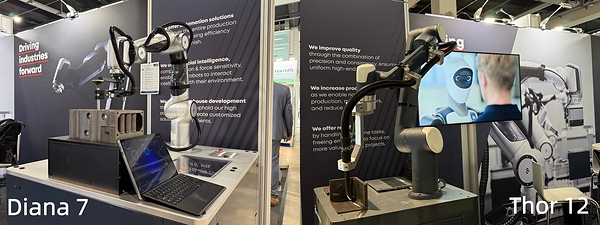
Agile Robots’ Diana 7 and Thor 12 demonstrations at all about automation in Zurich, August 2026. Archive press image: Agile Robots / PR Newswire. This is not a Hitachi customer deployment.
Hitachi and Germany’s Agile Robots have agreed to develop and commercialise physical AI for manufacturing, targeting factory tasks that remain difficult to automate when products, positions or working conditions change.
The partnership, announced on 29 September, brings together Hitachi’s industrial expertise and AI technology with Agile Robots’ portfolio of robotic arms, mobile machines and its Agile ONE humanoid. Hitachi intends to sell resulting solutions internationally through HMAX Industry, its industrial AI offering. Agile Robots will also take them to its customers.
The announcement identifies a commercial route, but does not name an initial customer deployment, disclose contract values or provide a rollout timetable. It is a development and commercialisation agreement; the partners have yet to demonstrate the operating results of their joint offering.
The work between established automation
The companies identify parts handling, machine loading, assembly, product changeovers and movement between manufacturing processes as areas of interest. Their argument is that changing workpieces and conditions still require judgement that fixed automation struggles to reproduce.
According to Agile Robots’ announcement, it will contribute AgileCore, its software for simulation, control and coordination. Hitachi’s edge AI semiconductors are also part of the programme, intended to process sensory information quickly while limiting power consumption.
AgileCore’s existing proposition extends beyond operating an individual robot. The company describes support for devices from different suppliers—including cameras, grippers, mobile robots and industrial controllers—alongside process monitoring and custom software skills. Those connections matter because a robot’s usefulness depends on the production system around it.
The business question is therefore broader than whether a machine can complete an impressive demonstration. A manufacturer needs to know how often it finishes the assigned job, how quickly an operator can recover from a failure, and whether a new product requires substantial engineering work.
A system that handles variation could reduce the effort involved in changing a production line. That benefit would have to be measured against installation, supervision, maintenance and software costs. The partnership announcement supplies no customer results that settle that calculation.
What would make the agreement commercially meaningful?
Named production deployments would be the next useful evidence. Buyers would also benefit from cycle times, intervention rates, operating availability and the time required to introduce a new task.
Those measures would help distinguish a flexible production tool from an experimental installation that still needs extensive support. They would also reveal where commercial value sits: in the robot, its software, the integration work, or the continuing service contract.
As Robot Harbour’s coverage of BMW’s humanoid factory trials explores, preparing a real workflow is a substantial part of deployment. Hardware capability alone does not establish that the surrounding process is ready.
The British opportunity remains to be defined
For British businesses, the announcement is relevant as a signal of how industrial robotics may be supplied. Robot Harbour’s assessment is that a larger technology and integration provider could offer a route from research to customer operations, while creating demand for installation, task configuration and field support.
However, neither release announces a UK customer, British pricing, a local partner programme or a service accreditation route for the joint offering. Those details would determine whether an independent British integrator or maintenance provider has an accessible commercial opportunity.
The agreement is worth tracking for its proposed route to market. Its significance will increase when that route produces identifiable customers and measurable operating results.