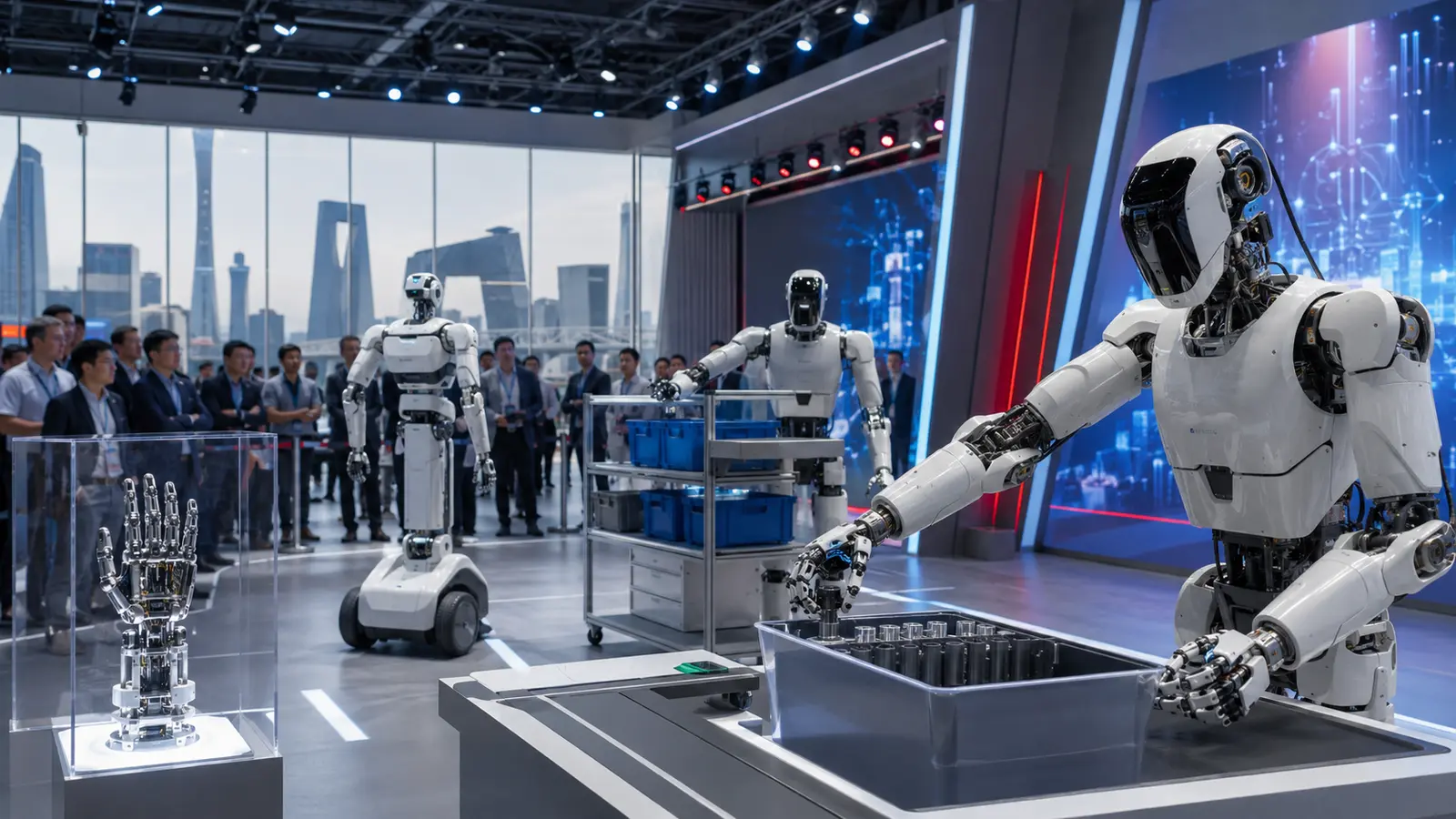
Featured image: Original Robot Harbour editorial illustration, generated for this preview.
World Robot Conference 2026 is scheduled to take place in Beijing from 19 to 23 August, bringing together robot manufacturers, component suppliers, researchers and policymakers at a moment when China holds a commanding reported lead in humanoid-hardware shipments.
Organisers expect more than 300 exhibitors, over 2,000 exhibits and more than 150 new product debuts. Those numbers make the conference potentially important—but the volume of announcements also makes careful filtering essential.
Robot Harbour will focus on developments that change what robots can reliably do, how they are manufactured, where they can be bought and supported, or how they are being deployed commercially. Choreographed demonstrations without technical or operational evidence will be treated accordingly.
When and where is World Robot Conference 2026?
- Dates: 19–23 August 2026
- Location: Beiren Etrong International Exhibition and Convention Center, Beijing E-Town
- Theme: Human–Robot Symbiosis, Industry–Demand Integration
- Expected participation: More than 300 exhibitors and 2,000 exhibits
- Expected debuts: More than 150 products
The event is organised by the Chinese Institute of Electronics. For the first time, its five days are divided into Release Day on 19 August, Procurement Day on 20 August, Developer Day on 21 August and public days on 22–23 August.
1. Product launches that customers can actually buy
Release Day is intended to concentrate product debuts, research results and collaborative initiatives. The strongest announcements will provide more than a model name and a stage performance.
Robot Harbour will look for disclosed specifications, production status, delivery timing, commercial pricing or a clear quotation route, and after-sales arrangements. A prototype presented in Beijing should not automatically be described as commercially available in Britain or Europe.
2. Whether Procurement Day produces orders
Procurement Day may be the more revealing part of the programme. Organisers plan purchasing negotiations and supply-chain matchmaking intended to connect robot suppliers with industrial demand.
The test is whether those meetings produce named customers, signed orders, paid trials or deployment programmes. Memoranda of understanding and non-binding partnerships will be labelled as such.
3. Whether shipment leaders can demonstrate useful autonomy
New analyst estimates place AGIBOT ahead of Unitree Robotics in global humanoid shipments during the first half of 2026. World Robot Conference offers both companies—and competitors including Galbot, UBTECH and Leju—an opportunity to show what those production numbers mean in practice.
The most revealing demonstrations will not necessarily be the fastest or most acrobatic. We will look for task completion without continuous teleoperation, recovery after failures, repeatability, useful manipulation, disclosed runtime and intervention requirements, and evidence that the capability is available to customers.
4. Hands, actuators and the component supply chain
Humanoid performance depends on much more than a foundation model. Dexterous hands, joint actuators, reducers, force sensing, batteries, perception hardware, motor control and functional-safety systems determine whether an AI command becomes a reliable physical action.
The expo will include suppliers of sensors, reducers, ball screws, motors, batteries, dexterous hands and integrated joints across four exhibition zones. Enabling technologies may prove more commercially significant than some complete-robot launches.
Robot Harbour will watch for components that improve manipulation, reduce power consumption, simplify maintenance or provide credible safety functions. Published specifications, production status and customer availability will matter more than conceptual claims.
5. Real-world trials and developer platforms
Organisers plan to launch a Global Robotics Application Exploration Program that will match mass-produced humanoids, quadrupeds and dexterous hands with innovation teams for free trials. Its value will depend on the selection criteria, trial duration, operating data and whether projects continue after the supported period.
Developer Day will focus on technical exchange and ecosystem building. The concurrent World Robot Contest is expected to include more than 10,000 competitors from over 6,000 teams across more than 20 countries, including challenges involving embodied-intelligence systems and brain–computer interfaces.
The contest should not be confused with the separate World Humanoid Robot Games, scheduled elsewhere in Beijing from 22 to 26 August.
6. The gap between demonstrations and deployments
A controlled demonstration can establish that a capability is possible, but it does not show that the robot can repeat the task throughout a commercial shift.
Robot Harbour will distinguish among:
- Demonstration: a capability shown under controlled conditions.
- Pilot: a limited test at a customer or partner site.
- Deployment: robots performing operational work over time.
- Scaled deployment: repeat orders or multiple operational sites supported by measurable results.
Evidence such as operating hours, intervention rates, cycle times and expansion beyond the initial site will carry more weight than a launch-stage performance.
UK and European relevance
WRC is an indicator of Chinese product pricing, export readiness and manufacturing scale. It matters directly because AGIBOT already has a UK distribution and rental route, while Unitree’s recent Shanghai IPO adds capital for expansion.
For British and European buyers, the relevant questions are whether newly announced products have authorised local distribution, warranty and repair support, documented conformity, transparent data handling, secure software updates and commercial pricing or rental options.
For European developers, WRC will show how quickly Chinese competitors are moving down the cost curve—and whether they can translate production scale into reliable deployment. It also underlines the importance of regional strength in components, safety engineering, integration and physical AI.
What Robot Harbour will cover
World Robot Conference is expected to generate far more material than any specialist publication should repeat indiscriminately. Our coverage will prioritise significant new platforms, verified advances in autonomy or manipulation, manufacturing and delivery milestones, commercially relevant components, confirmed customer orders and deployments, safety and regulatory developments, and concrete implications for the UK and Europe.
The central question is not which robot produces the most spectacular clip. It is which announcements move the industry closer to reliable, supportable and economically useful machines.