HyLight has raised €13m to expand a business that combines hydrogen-powered airships with software for inspecting electricity networks, gas pipelines and railways, as European infrastructure operators test alternatives to conventional aerial surveys.
The French company’s funding announcement, released on 12 October, names Rubio Impact Ventures, DRW and Teampact Ventures alongside existing investors Y Combinator and Ring Capital. HyLight says the money will support aircraft production, automated data analysis and European expansion, with Germany and the Netherlands its priority markets.
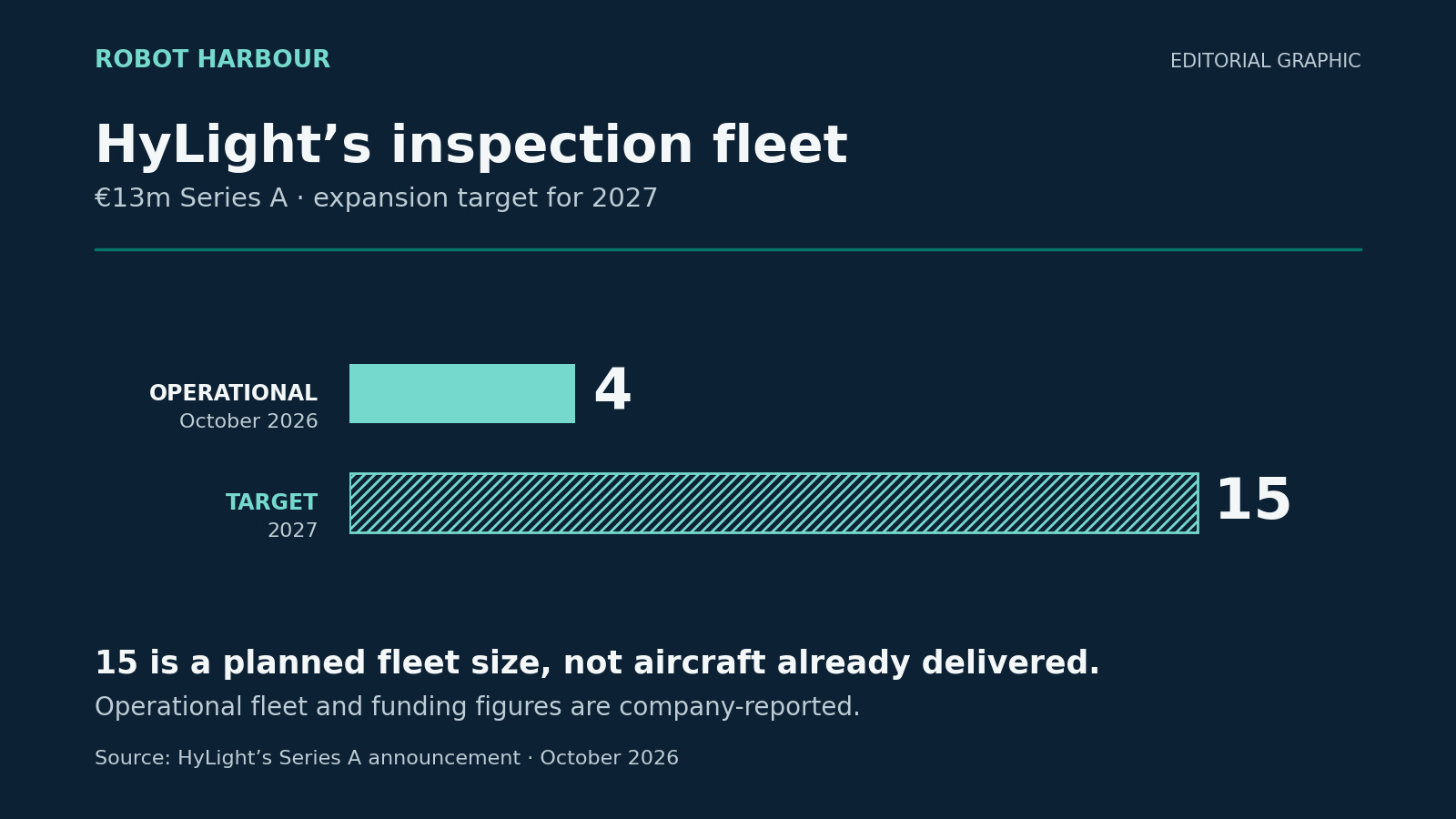
The financing follows actual inspection work. In its accompanying company announcement, HyLight reports four aircraft in operation and 7,000km inspected. It aims to operate 15 aircraft in 2027. Those are company-reported figures; the larger fleet remains a target.
The commercial proposition extends beyond an aircraft. HyLight operates the equipment and processes the resulting data, offering customers information for maintenance decisions. Its expansion will test whether that combined service can scale economically.
Inspection findings that enter the maintenance system
There is customer evidence behind the proposition. A September case study published by E.DSO, with an Enedis project contact, describes trials across five French regions. These identified corrosion, damaged insulators, vegetation encroachment and other network defects. The findings entered Enedis’ asset-management processes.
That connection matters. Collecting images is only one part of an inspection service. Operators must also assess the findings, establish their significance and decide what work to commission.
The same case study sets limits on the progress achieved. It describes an ongoing experimental programme intended to establish performance at greater scale, including safety, operating efficiency and competitiveness against helicopters and conventional drones. It does not establish that HyLight has already met those objectives.
The document also records French operating authorisations obtained in November 2025, enabling long-range inspection outside restricted airspace. Operational permission creates scope for expansion; it does not itself prove the economics of supplying the service.
Automated flight still involves people
A separate Teréga and HyLight announcement, dated 2 February 2026, describes testing along a 107km gas-pipeline section between Cazilhac, Narbonne and Claira. The aircraft carries a Pergam Falcon+ methane-detection sensor, with its results intended for comparison against helicopter surveys.
Teréga explicitly describes ground operators and a remote pilot. Its planned flights required risk assessment and the necessary regulatory permissions. Describing the aircraft as autonomous should therefore not imply that the service runs without human supervision.
The announcement also clarifies the aircraft’s configuration: helium provides lift, while a hydrogen fuel cell supplies electric propulsion. Claims about the absence of greenhouse-gas emissions refer to flight, rather than a published assessment of the complete equipment and energy supply chain.
The AI opportunity—and the unanswered questions
HyLight’s technology presentation describes a service that combines LiDAR, optical imagery and gas-detection sensors with AI-assisted anomaly detection and infrastructure visualisation. This places the business within applied AI: software helps turn measurements from the physical world into information for operational decisions.
Its funding announcement says the company wants to strengthen that analysis as its fleet expands. More aircraft can increase data collection, but the value to a customer depends on what happens afterwards.
The material reviewed does not provide a standard price per kilometre, independently assessed detection accuracy or a quantified return on investment. Nor does it establish how much analyst review is required for each survey, how frequently the AI raises false alarms, or how weather affects completed work and cost.
These are substantive questions for buyers. An inexpensive flight can become costly if its findings require extensive checking; a more expensive survey can justify its price if it reliably identifies problems early enough to change maintenance decisions. The same evidence questions arise across physical AI and robotics.
A European opportunity with UK access still unconfirmed
The announcements identify no British deployment, UK ordering route or local service-partner programme. For UK readers, the immediate significance is a developing European inspection model, rather than a confirmed domestic rollout.
Potential work could encompass field operations, sensor maintenance, data integration and continuing inspection contracts. Access to that business would depend on HyLight’s expansion plans and the capabilities required of any local partners.
For now, the strongest evidence is the combination of operational aircraft and named utility trials. The next commercial milestone will be showing that those trials can become repeatable inspection services with disclosed performance and costs.
Explore our directory profiles for HyLight and its HyLighter inspection airship.
Reporting is based on HyLight’s announcements and customer documentation from Enedis and Teréga. Operating figures are attributed to their sources; Robot Harbour has not independently tested the aircraft.
Image: Robot Harbour editorial graphic. Fleet figures are company-reported; 15 aircraft is a 2027 target.